


Obama Gives Detroit Its Best Day In Decades
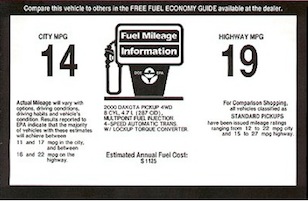
This is a story of supply and demand. On the demand side of the equation, President Obama has put in place landmark new vehicle mileage standard for cars and light trucks. By 2016, cars must achieve 39 miles per gallon in city + highway driving. Light trucks must average 30 mpg. How aggressive is this standard? Less than a handful of cars and no trucks can meet it today. Yet everyone from Detroit to retired military brass and Republican leadership support it.
Why? Read on to see why President Obama has given Detroit’s its best chance in decades.
Betting The Farm On The Right Curve
I’m going to show you the prices of three energy sources (e.g. oil or wind or coal in say, dollars per barrel) over time. (For you geeks, these are all in 2008 $ and the source is the U.S. Dept. of Energy)
US taxpayers have subsidized one of these energy sources for nearly a century with tens of billions of $ of tax breaks and other easements every year. As a result, we now depend upon this source of energy above all others.
You as President, must decide which energy sources you support and which you think the United States should wean itself away from.
From the mystery charts below, pick the two energy sources you think would be best for the American people and click Read More to find out what they are...
1.

2.
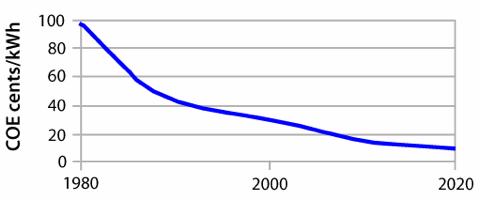
3.
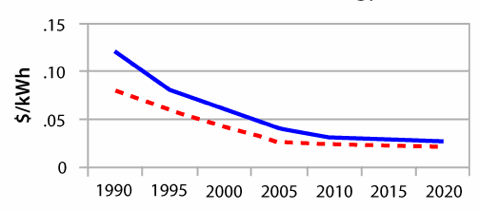 Read More...
If You Read Just One Book This Year...
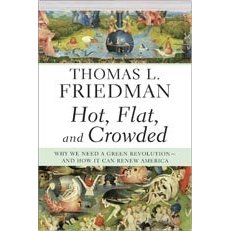
This book should be required reading for everyone in the developed world. That’s a strong statement and I’ll preface it with the fact that I often find that three-times Pulitzer Prize winner Thomas Friedman’s New York Times writings sensationalist.
Hot, Flat & Crowded, (winner of Washington Post, Chicago Tribune & Business Week Book of the Year) is different. It’s visionary, well researched and page-turningly well written. It offers a new path away from the growing consequences of our increasingly hot (climate change), flat (rapidly expanding global middle class), and crowded planet.
To begin with, the book demonstrates there is simply not enough energy to fuel a 10x growth of the world’s consumptive middle class driven by China & India if this middle class consumes as much resources (energy, water, land) as we do today. If you buy this thesis (and it’s hard not to, based on the evidence we saw in the summer of 2008 with skyrocketing commodity prices, record pollution and temperatures) the question Friedman begs is: now what?
Here is the visionary part: Friedman creates a wholistic (and fact-based) perspective of how an resource-efficient, economic, clean and sustainable low/no carbon economy can be built with existing and maturing technologies. And it offers a path to return the United States to the forefront of its historical leadership: exporting new technologies - something we have lost in the past 15 years.
If this all sounds horrendously dull, it’s not. The inspired vision is matched by inspired writing. Get it here. To save some paper and energy, read it on your Kindle 2 or get it from your library.
HCR-188c The Holy Grail Of Refrigerants?
What if a refrigerant...
- Reduced refrigerator and A/C energy consumption by over 30%
- Cost just 1/3rd of conventional refrigerants
- Has 96% less global warming impact than conventional refrigerants
- Has zero ozone depleting impact
What if this breakthrough was not developed by a giant chemical company, but over the past 15 years by a passionate former mechanic in Hawai’i?
Mr. Maruya of Kane’ohe Hawai’i could be one of this century’s energy heroes.
The EPA has just approved Mr. Richard Maruya’s remarkably simple HCR-188c refrigerant. Haier the Chinese white goods giant has provided research assitance, while Greenpeace has given him recognition.
While we would love to see the world beat a path to Mr. Maruya’s door, his challenge may be just beginning...Read More...
We Need Global Auto Standards

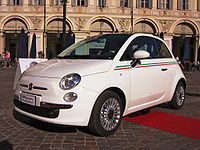
The Renault Espace and Fiat 500 are just two of the cars that could be built in the US IF government regulators are serious about helping our auto industry turn around.
An insightful recent New York Times article points out that the US auto industry could transition to more efficient vehicles quickly IF the US government transitioned to more efficient regulations.
GM and Ford both produce outstanding and efficient vehicles in Europe. These vehicles could be produced quickly in the United States if (already similar) safety and emissions standards were “harmonized” (at least temporarily) to allow European-spec. vehicles to operate here.
This would allow European-spec. vehicles to be built and sold in the U.S. - AND cut the cost of government regulation. Let’s see if our government figures what’s good for the goose (US auto industry ) is good for the gander (government regulatory organizations.)
Bolder, less “Americanized” versions of non-US cars have recently been selling briskly: Audi’s range is the fastest growing in the luxury sector and Nissan and VW have also seen success with more stylish & less Americanized versions of their products.Read More...
China Ends Fuel Subsidies - Will Others Follow?

China, the world’s #2 oil consumer behind the US, has demonstrated a remarkable show of economic force: it eliminated fuel subsidies and let oil prices float. Better yet, it increased gasoline tax 500% and diesel tax 800% to about $0.14 per liter ($0.50 per gallon.)
OPEC predictably reacted allergically but the real question is will other fuel subsidizing countries like India, Mexico and Indonesia follow? Here’s why they can and should now.Read More...
At Last: EU Ends The CFL Tariff...
 The headline news was the EU ban on incandescent bulb sales beginning in 2010... The more important but unreported news was the EU quietly letting its usurous 66% import tariff on Chinese-made CFLs lapse...Read More...
The Ten (Energy) Commandments
 I’m not the President, King, or a holy deity. But if I were, here are my 10 Commandments of Energy. I’d love feedback - what SHOULD the energy 10 Commandments look like?
1. Nations such as China, India, Mexico and Iran should stop government fuel subsidies that increase global oil usage up to 15%, drive up energy prices and hurt government financial stability. Read More...
Shame on the EU's CFL Tariff
 My parents live in Britain. They wondered why CFL lightbulbs that reduce energy cons cost three to four times what they cost in the rest of the world. The BBC revealed that the EU renewed its 66% (!) tariff on Chinese...Read More...
Time For Airlines To Pay Fuel Tax


Unlike every other transportation mode, airliners don’t pay fuel tax.
Trains pay fuel tax, cars & buses pay, ferries and ships pay, trucks pay. (So do farm tractors and construction equipment.) Airliners don’t and this is neither right nor fair.
It is time to fix this now.
Free Rider...
Unlike vehicles, trains, boats and other fuel users, airlines pay no or fuel taxes virtually worldwide. In the U.S., airlines pay 8% of what other transportation methods use. They also do not pay state sales taxes while ferries and other transportation do.
This means other transportation methods subsidize airlines.
What To Do?Read More...
Radical Remaking Of Utilities...
You were an electric or gas utility whose profitability was regulated by the Public Utility Commission? (almost all are) and face regulatory, demand and fuel cost challenges?
• Permitting and building new power plants got more difficult and costly every year...
• Fuel costs rose and became more unpredictable each year and customers reacted by reducing power consumption...
• The business risk of carbon cap & trade or carbon taxes was growing each year...
What if you already had the names, addresses and billing information of 100% of hundreds of thousands of consumer and business customers concentrated in one region... Read More...
Send a Message to Congress: Do The Right Thing
Our government will PAY YOU to Use Half

Like to receive $10,000 in tax credits and rebates if you buy a car, insulate, replace light bulbs and add solar water heating and perhaps $2,000 or more off your gas and utility bills every year for ever...? Read More...
DOE, EPA & Utilities Launch National Action Plan For Energy Efficiency
The goal of the National Action Plan for Energy Efficiency is to create a sustainable, aggressive national commitment to energy efficiency through gas and electric utilities, utility regulators, and partner organizations.
OK, it's a start. But tell us why utilities aren't already the largest retailers of energy saving light bulbs or fans? They already have our shipping addresses and bill us monthly. We can simply check a box on our bill and receive products a week later. If they prefer not to stock & ship the items themselves, they can outsource and take a sales commission from a mail order fulfillment house. The business is likely to be more profitable than power generation and is unregulated.